


Your video archive contains data that AI can't summarize

Where is all the brand video you've ever shot?
These days, people don't search for information anymore. They just ask AI, read the summarized answer, and call it a day. This means your brand only truly becomes discoverable to the world when AI knows who you are and cites you as a source.
But here’s the catch. AI can't watch your video. That's why your footage is still a cost, not an asset — and here's how to give it wings.
How much video has your brand shot over the years? Campaign films, product shoots, live broadcasts, event footage, raw YouTube cuts — where is all of it now?
Most of it is scattered across external drives and cloud storage somewhere. The project wrapped, the footage was forgotten. And when you need "that one shot" again, you hunt for a while, give up, and just reshoot it.
Inside that footage is an asset you already paid to create — and can no longer pull back out.
Why isn't your video archive "data" yet?
A video file is a black box. Until someone opens it and watches the whole thing, no one knows what's inside — which products appear, how often, who said what, what happens when. You can't search it. You can't ask it a question.
This isn't a corner case. Analysts estimate that roughly 90% of all enterprise data is unstructured — video, audio, images, documents — and the majority of it is never analyzed (IDC). There's a name for information you collect and pay to store but can't actually use: dark data, which by most counts makes up more than half of everything enterprises keep. Video is one of its heaviest, least-searchable forms.
And here's the fact that matters most: AI can't watch your video either. AI search reads text. A raw video file is just a heavy blob to it — not something it can read, index, or cite.
So your archive isn't data yet. It's just storage.
What does it mean to make video searchable?
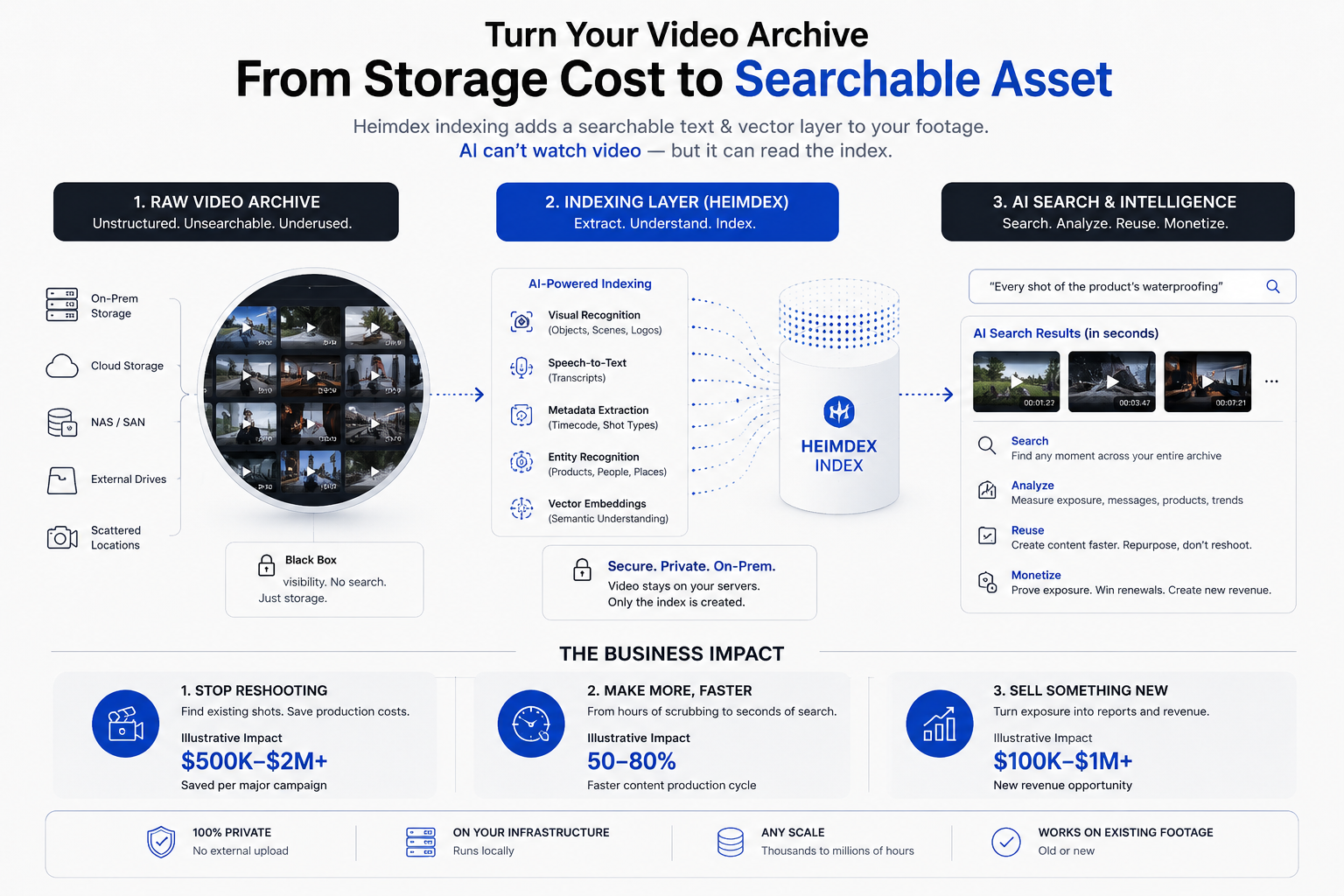
Video indexing layers searchable text and vector data over raw footage — capturing what's on screen, what's said, and which products appear when — so the footage can be searched, analyzed, and reused. Without it, a video file is dead weight; with it, the archive becomes queryable data. This searchable layer is what turns passive storage into true video asset management, and it's what makes AI video search possible at all.
The moment that layer exists, three things become possible that weren't before.
1. Search it. "Every shot where we showed the product's waterproofing" — in seconds, not hundreds of hours of scrubbing. And because the layer is text, AI can read it too. It still can't watch the video, but it can read and cite the summaries and tags pulled from it. A dark archive becomes discoverable for the first time. This is no longer optional: roughly 60% of Google searches now end without a click, and when an AI answer is shown that rate climbs past 80% (Bain, Semrush, 2025). Discovery increasingly means being the source the AI cites — and it can only cite what exists as text.
2. Analyze it. Not one clip — the whole archive's patterns become measurable. Which product, which message, in which context appeared on screen, and how often. Numbers that no single clip ever showed you surface in aggregate.
3. Reuse it (and sell it). The shots you find become source material for shortform, ads, and product pages — repurposed, not reshot. And if you manage partner brands or advertisers, that aggregate becomes an exposure report you can sell, or use to defend a renewal.
The video is grounded. The text layer is the wings.
How much money is locked in your video archive?
Let's turn the abstract into money. Start with what the archive costs you right now: analysts estimate enterprises waste up to $2.5 million a year storing data they never use (Komprise) — and video is among the most expensive to keep. Indexing turns that sunk storage cost into something you can actually draw on. It pays off three ways. (Figures are illustrative — plug in your own.)
Lever 1 — Stop reshooting (production savings). The biggest one. The shot you need for a new campaign, a new short, a new product page already exists in old footage — you just can't find it, so you reshoot. Think about the cost of a single shoot: crew, gear, talent, location. The moment footage is searchable, the "reshoot" becomes a "reuse."
Lever 2 — Make more, faster (content throughput). One shoot yields dozens of shortform cuts. The hours an editor spends scrubbing the original for "that moment" collapse into a single search. The same team ships more content, on a faster cycle.
Lever 3 — Sell something new (reporting & proof of exposure). If you manage partner brands or advertisers, a report — "your product appeared 14 times for 22 total minutes in this month's video" — becomes new revenue and a renewal argument. The production cost is footage you already shot; the marginal cost is near zero.
The point is that none of this requires shooting anything new. It comes out of footage you already have — turning the storage bill you pay every month into an asset.
Does your video ever leave your servers?
No. None of this requires uploading a single frame. Heimdex indexing runs locally on your own infrastructure, and the only thing it builds is the text-and-vector layer. The originals stay exactly where they are. Sensitive brand masters never touch an external cloud.
FAQ
Does this work on old footage I shot years ago?
Yes — that's the whole point. Indexing targets the archive you already have, not new shoots. For a 10,000-hour archive, initial indexing runs in the background in 24–72 hours, and from that point your entire back catalog is searchable.
Do I have to upload my original video anywhere?
No. On-premise indexing analyzes footage locally on your existing infrastructure. The video stays where it is; the only thing created is the index, which also lives on your own storage. Cloud upload is not part of the process.
Can it handle footage scattered across different locations?
Yes. The point isn't to gather originals into one place — it's to lay a single searchable text layer across scattered footage, so you can find anything with the same query no matter where it lives.
Your video archive isn't a cost. It's an asset you haven't pulled out yet.
The video is grounded. The text layer is the wings.
Search it, analyze it, reuse it.
👉 See how Heimdex puts wings on your video — with zero external upload: heimdex.co
